So, you’ve invested a ton of time and resources in SEO to reap the rewards of rankings and traffic – but what then? Without some form of conversion that affects your bottom line, what do you have to show for all your hard work?
Conversion optimization is a progressive and scientific way to ensure your site is performing for you once a person arrives at it. I sat down with Scott Fowles, an SEO analyst at Bruce Clay, Inc. who approaches SEO with experience in conversion optimization, testing, Web development and graphic design. I asked him about this new and often overlooked optimization trend for websites.
Q: What is conversion optimization?
Scott: Conversion optimization is both an art and science. It offers methods for making strategic variable changes to a Web page in order to improve its performance and ultimately boost your bottom line. To identify conversion factors you must first understand what goals you have for any given Web page and how visitors are expected to accomplish those goals.
Ultimately, you want every page on your site to funnel visitors toward conversion goals. A conversion can be any action that moves a visitor further down the conversion funnel, whether it’s a phone call, filling out a form or even just a microconversion click-through. Using various methods of scientific testing, conversion optimization helps you realize improvements that can be made to increase the performance of your website.
What does testing consist of in conversion optimization?
Many site owners shy away from conversion testing because of the potential negative impact it could have. Since conversion testing is just that: testing – there is intrinsic value even if the testing produces fewer conversions on a Web page than it did prior. This way, you know what not to do. It’s important to keep in mind, though, that educated testing seldom produces negative results, and even in the instance that negative results occur, you are not bound by those results.
Typically a test can run anywhere from a few weeks to a month, so we’re talking a very short-term period that likely won’t have a lasting negative impact on a business. Also, the benefits of knowing what you should not do to your site based on negative test results can easily justify the value of having to run that test. As a benchmark, both Google and Amazon have reported that roughly 50 percent of all the tests they engage in report negative results, yet both companies continue to test vigorously.
One example of a site that saw huge monetary gain before launching a scientific test is Overstock.com. Bryan Eisenberg suggested that they change their shipping proposition to “free”. Since high shipping costs are the leading factor in shopping cart abandonment, this one change wound up being worth several million dollars to Overstock’s bottom line.
How does conversion optimization relate to SEO?
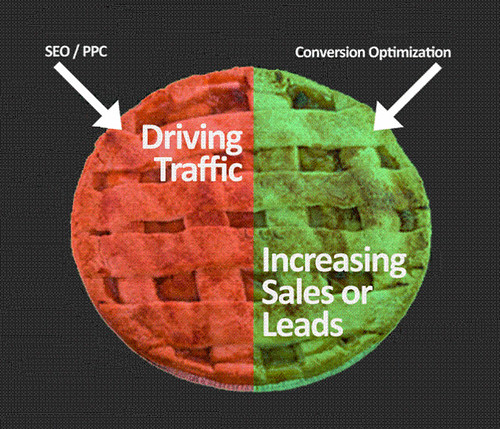
Conversion optimization and SEO go hand in hand. They are essentially two halves of the same pie. SEO drives traffic to your site, and conversion optimization makes your site perform better for that traffic by increasing sales, leads, click-throughs or other goals that you may have.
Why is conversion optimization important right now?
Conversion optimization is important for any website owner for at least these three reasons:
- Your customers are leaving you. According to a Forrester Research report in 2009, the average conversion rate for a website was 3 percent. That means on average, 97 percent of people who visit a site, bounce without making a conversion.
- You’re losing money. By retesting the same Web page over and over in iterations, you can continuously improve that page’s performance and claim more of the money that you essentially lose every time a visitor bounces. Each time you make an improvement to one of your pages, that improvement continues to perform even after the test is complete.
- Your competitors are already testing. A few years ago, nobody really knew that Internet conversion testing was something that people did. These days, that’s changing, and conversion optimization is growing. Top competitors in just about any niche imaginable are likely participating in some form of conversion testing. For instance, companies like Google and Amazon have several hundred tests running on their live sites at any given time. Chances are, you have already been a participant in one of these tests without knowing it.
Where do you see conversion optimization headed?
My predictions are that within the next two years, conversion optimization will be at least on an even playing field with SEO, as far as popularity and global reach are concerned. I’m amazed at how many new faces are involved in conversion optimization every day. It’s looking a lot like SEO did in the late 1990s.
Of course, the methods and approaches that we currently use for conversion optimization and testing will continue to evolve over time, and they may eventually be different than what we use today. This is because conversion optimization is all about good ideas. Everyone has good ideas from time to time, which tells me that we will continue to see new faces and new ideas that change the way that we do business on the net.
What are the crucial concepts within conversion optimization?
I think Bryan Eisenberg puts it best: always be testing! A boardroom full of executives or marketing personnel could sit around for weeks thinking up great new designs, product placements, navigation, headlines, images and so on; but in the end, all they will have is educated guesswork at best.
In fact, many times the marketing executives are so out of touch with their actual customers that calling it “educated guesswork” isn’t even valid. Only through scientific processes and testing, can we truly validate those ideas and know for sure whether or not they are effective. To me, that is the most crucial concept behind conversion optimization.
In general, what are some basics that can be applied to increase conversions?
Well, the two major parts of conversion optimization are actually the hardest to determine. Those are: 1) Who is your audience? and 2) What are your goals for that audience?
There are many resources that can help you to understand the demographics of your site, such as Compete.com. Analytics tools and persona development strategies can help to identify the psychographics of your site’s audience. Understanding demographics and psychographics together will help you to target your actual customers, rather than the visitors you think are customers.
You need to always keep your goals and audience in mind, even when designing elements like your “add to cart” button or hero banner call-to-action. Even without testing, changes that are oriented around your audience will typically show some improvements. And through testing, you can increase the success of those improvements.
What can a person do to get started with conversion optimization?
I’m a big fan of Google’s Website Optimizer software. It’s free, and quick and easy to install on just about any site. Google’s platform allows you to run all types of split and multivariate tests. Those are the most basic and common forms of conversion testing on the Web. Of course, there are also several companies that specialize in conversion optimization and can help you initiate the tests properly, and also offer up some proprietary alternative methods for testing.
What if someone is having trouble with executive buy-in for conversion optimization?
This is a great question that comes up a lot, mostly in smaller businesses. In small businesses, the president of the company typically plays a big role in the overall design of the site. This gives the person in charge sort of a “parent” complex, where he or she views the site as his or her child, and directives are often subjective. This is in contrast to what the website should actually be treated as: a salesperson.
The best way to counterbalance the parent mentality is through the use of hard evidence and facts. One approach that usually yields results is the “it’s only testing” approach. This shows your boss that the changes you’re proposing are only temporary, unless they should outperform what already exists.
Be prepared when you meet with your boss. Go in armed to the teeth with case studies and examples of real-world results. These days, a single Google search can dig up countless case studies to support your cause for conversion optimization.
Where can people learn more about conversion optimization?
There are so many great sites that provide info to people who are interested in conversion optimization. Two of my favorites are Seth Godin’s blog and Bryan Eisenberg’s blog. Anne Holland’s Which Test Won site is also a great critical-thinking resource.
Related posts:
- Increasing Conversions through Better Usability
- How Much Testing Is Too Much?
- Pay Per Click Track: Pump Up Those Conversions!
- Measuring How Search Ads Drive Offline Conversions
- Landing Page Testing & Tuning: SES New York

About the Author
Jessica Lee -
Writer/Producer - Jessica joined Bruce Clay in 2010, bringing with her years of experience in writing for magazine publications, online media and corporate communications, as well as a background in public relations and marketing. She has a degree in communications with a public relations emphasis from San Diego State University. Jessica has also been known to hug a tree and literally wouldn't hurt a fly (she prefers the trap-and-release method). Follow her on Twitter
@JessicaBCI 

 Matt asked if I would write a guest post about how I use Facebook in my business. I don’t profess to be a Facebook expert and certainly not a guru. I’m just small business owner trying to find my way in the world. (I’m a real estate agent in a vacation destination with a population of about 7,000.)